

Cognitive Warfare: the Illusion of Novelty
Marketing, Ignorance, and the Cognitive Warfare Trap
This post began as a critique of an article asking, “Why is the US Losing the Cognitive Competition?” I was tempted to ignore the piece entirely, given its defective analysis and the author’s failure to answer the very question they posed. However, it seemed to serve as a fitting companion to my recent review of “cognitive warfare.”
While pointing out the article’s failures was effortless—and helpful in highlighting broader issues in the discourse—I struggled to articulate precisely why this specific piece warranted a critique, or why it was worth your time and mine, beyond its timing. I ultimately spent way too much time on this, nearly abandoning it more than once. I found myself stuck trying to bridge the gap between the intuitive value of exposing “cognitive warfare” and a concrete purpose I could clearly articulate.
The answer I finally reached was no, the article itself wasn’t important enough to spend more time on. That said, I felt my criticism shouldn’t go unsupported, so an abbreviated critique is here. Wrestling with the topic caused me to dig deeper into the “cognitive warfare” discussions. Between the Hoffman literature review, the article above, the Wikipedia entry, peer-reviewed articles, and other sources, there was something fundamentally broken in the invocation of “cognitive warfare” that I needed to explore and address.
The research led to an unavoidable conclusion: “cognitive warfare” is a buzzword that recycles established concepts while adding no new theoretical or practical value. Its primary—and laudable—function is to elevate a neglected area of national security, but it does so through claims of originality that rely on a lack of historical memory.
The repackaging of old concepts as fresh ideas, whether intentional or unwitting, is not without problems. This repackaging and false claims lead to reductive analysis and poor prescriptions. Fundamentally, it squanders our time and resources by forcing a relitigation of lessons we should have learned decades ago.
I need to establish three things before moving on. The first is a structural flaw that is pervasive in “cognitive warfare” analysis. Authors frequently cite the expansive, multi-domain doctrine of adversaries—notably China—to establish the magnitude of the threat, only to abruptly pivot to advocating for narrow, often tactical, and often military-centric capabilities. While they are often right to argue that these capabilities are marginalized by military and political leadership too focused on kinetic warfare, the disconnect between the broad threat and the niche solution is glaring.
That authors rarely acknowledge the disconnect between the broad threat they describe and the narrow solutions they offer is not a mere oversight; it is an analytical failure enabled and unchecked by a lack of serious scrutiny. By omitting a simple disclaimer—such as “this is only one component of a necessary response”—they implicitly suggest that their niche capability is an adequate counter to a comprehensive strategy. In effect, they are passing off incomplete prescriptions as complete.
The second point ties into the first: military authors overwhelmingly dominate the analysis of “cognitive warfare.” This is not just because the defense community is threat-focused, but because it actively fosters a culture of public analysis. Through an extensive ecosystem of journals and professional outlets, the military encourages its members to publish, debate, and refine ideas in the public sphere—a level of support largely absent elsewhere.
However, this monopoly creates a predictable bias. Authors naturally anchor their prescriptions in what they know best: military organizations, capabilities, and activities. The problem is not their focus, per se, but their framing. They rarely include the necessary caveat that their proposals represent just one brick in a much larger wall.
A broader intellectual failure reinforces this bias. Aside from the niche world of covert and clandestine operations, the national security establishment has consistently marginalized this topic, treating it as irrelevant to “serious” statecraft. Consequently, academic institutions have failed to teach these age-old methods, producing generations of scholars, policymakers, and pundits with little to no grounding in the subject. To them, these concepts appear novel only because their education ignored them
A notable exception to the military-centricity is “Cognitive Combat: China, Russia, and Iran’s Information War Against Americans,” which acknowledged:
Warfare is the preserve of the Department of Defense, but much of the information war being waged against Americans occurs beyond the Pentagon’s reach. Accordingly, an American approach to information warfare that relies excessively on the Pentagon to respond will not be effective.
Adopting this holistic view leads to a deeper understanding of adversarial methods and enables a more coherent response. Accordingly, “Cognitive Combat” introduced its recommendations by stating,
A whole-of-American-society counter-offensive is necessary to combat China’s cognitive warfare strategy. To be successful, this approach should include hardening America’s democratic defenses; exposing China’s malign activities and countering them when appropriate; and penetrating China’s domestic information environment to undermine false narratives about the CCP’s legitimacy.
The third point is perhaps the most frustrating: the persistent argument—whether implied or explicit—that meaningful change is merely contingent on understanding the threat. Even if we adopt a charitable view of the authors’ intent, this premise is flawed. Rarely do they identify the true obstacle: a profound absence of political will.
I am old enough to remember declarations of “information warfare” dating back nearly a quarter of a century. The importance of public opinion didn’t magically materialize then; we simply had a seemingly vague realization that it mattered, sort of. Ultimately, we failed to adapt to the changing environment, while our adversaries did not. Because this concept remains absent from scholarly and national security curricula, we are left with a class of policymakers, legislators, and pundits who lack the educational foundation to act. Even when they seem to understand the problem, a closer read quickly reveals they do not.
This raises an inconvenient truth that virtually all recent analyses ignore: none of these declared vulnerabilities will be addressed anytime soon. This administration appears to welcome, if not embrace, adversarial interference from nations like Russia, while relying on the very weaknesses targeted by “cognitive warfare” doctrine to advance its own agenda, both at home and abroad. It finds political utility in the distraction and division such activities generate—or simply treats these incursions as negotiable pawns in a broader diplomatic game.
While the current administration is complicit, prior administrations were negligent. There is plenty of blame to share. The reasons we are debating the basics of adversarial “cognitive warfare” in 2025 are deep-seated and long predate the current leadership.
Given that national security discourse remains heavily anchored in military frameworks, it is necessary to revisit the foundations of the debate. To the historically minded, war is fundamentally the waging of politics through selective means. A strictly violence-centric definition privileges physical combat, obscuring the reality that war is a clash of political objectives where the enemy’s will—not just their forces—is the primary target.
The common trope regarding “long-held Western conceptions of war” is often a cover for a self-imposed myopia. This defect biases us toward kinetic operations and blinds us to the utility of non-military instruments, leaving us struggling to grasp a reality our adversaries embraced for many decades: that politics is waged through a spectrum of means far broader than the military alone.
It should not be this way. The concept of non-kinetic warfare should not run against the grain for any serious reader of Clausewitz. That it does is arguably due to a subtle but significant shift in how On War has been translated for modern strategists. While non-kinetic methods align perfectly with Clausewitzian thought, the standard 1976 translation by Michael Howard and Peter Paret obscures this by defining war as political intercourse with “the addition of other means.”
If we return to O.J. Matthijs Jolles’s 1943 translation, we find a meaningful difference:
We maintain, on the contrary, that war is nothing but a continuation of political intercourse with an admixture of other means. We say “with an admixture of other means” in order thereby to maintain at the same time that this political intercourse does not cease through the war itself, is not changed into something quite different, but that, in its essence, it continues to exist, whatever may be the means which it uses, and that the main lines along which the events of the war proceed and to which they are bound are only the general features of policy which run on all through the war until peace takes place.
The distinction is profound. “Addition” implies something layered on top, like icing on a cake; it is distinct and separate. Jolles’s “admixture” better captures the complexity: it implies a blending, like an ingredient that alters the consistency, taste, look, and nature of the whole. This definition supports a reality where military means remain inherently political, bridging the gap between cold and hot war.
However, Clausewitz’s original German text drives the point home: “Wir behaupten dagegen, der Krieg ist nichts als eine Fortsetzung des politischen Verkehrs mit Einmischung anderer Mittel.” The pivotal word Einmischung translates as interference, intrusion, or meddling, specifically within a social or political context. While “admixture” suggests a blend, Clausewitz’s actual language is far more aggressive. He described war not just as a mixture or layering of ingredients, but as a forceful, disruptive intervention in the political process.
Taking this interpretation to heart, it appears our adversaries may understand Clausewitz better than we do. This concept of active political interference perfectly characterizes operations in the so-called “gray zone”—actions below the threshold of overt military violence.
Even the term “gray zone” is flawed, at least as it is commonly used. It implies a shared state of ambiguity, yet the reality is often dangerously asymmetric: one side believes it is at peace, while the other knows it is at war. To understand how our adversaries target us, we must discard this binary. We must view conflict as a continuous political struggle, where the difference between “cold” and “hot” war is distinguished only by a thin line of escalation. Our adversaries certainly do.
Our reliance on conventional military deterrence has cemented a “Maginot mentality.” A rational adversary has no incentive to assault us head-on. Instead, they use means intentionally designed to operate below the threshold of military retaliation, the gray zone.
The logic is sound: why engage in a high-cost kinetic war when you can achieve political objectives without the need for an occupation army or post-conflict reconstruction? This method allows for repeated, low-cost assaults on our strategic interests. Henry Kissinger warned of this exact danger in 1955, noting that a rigid reliance on military force leaves us “paralyzed,” unable to respond to threats in the “grey areas” that do not justify total war.
A fundamental problem with “cognitive warfare” is the sense it labels a new threat enabled by new technology. I reviewed NATO’s Allied Command Transformation website, prompted by Frank Hoffman’s “Assessing Cognitive Warfare,” which defines the concept as “attacking and degrading rationality” to exploit vulnerabilities and weaken systems. The site notes that Russia aims to “decay public trust towards open information sources,” while China views it as a combination of “public opinion, psychological operations, and legal influence.”
French officer François du Cluzel, whom Hoffman cited (quoting a 2018 paper; I used a 2022 edition found here), defined “cognitive warfare” as “the art of using technologies to alter the cognition of human targets... without their knowledge and consent.” While Hoffman rightly questions whether du Cluzel’s distinction between psychological and cognitive operations is valid, his subsequent explanation falls into the same trap.
Hoffman wrote, “For du Cluzel, psychological warfare attempts to change what the target audience thinks, but Cognitive Warfare aims at shaping how they reason and their resultant behavior.” This creates a false dichotomy. If a meaningful distinction actually exists between changing “what they think” and shaping “behavior,” then the former is strategically useless. After all, what is the utility of influencing thought if the ultimate goal isn’t to influence behavior?
Technology serves as the conceptual linchpin in the “cognitive warfare” literature; it is the primary means proponents use to divorce the term from historical precedent. This also applies to the defensive realm of “cognitive security.” For instance, the 2024 article “Cognitive Warfare: The Fight for Gray Matter in the Digital Gray Zone” explicitly tied its definition to the method rather than the outcome, describing the threat as influencing a population “using technical means and information.”
Similarly, the 2022 article “How China’s Cognitive Warfare Works” argued that modern science and information technologies created an entirely new domain. The authors defined “cognitive warfare” as moving beyond mass communication to “brain control,” depending “more on neurological resources than just mass communication techniques.”
However, this requires remarkable analytical gymnastics. Despite admitting early on that the concept “is not new,” these authors summarily dismiss related historical notions without substantive argument. Their cursory mention of “political methods” to influence cognition or opinion, cited a source equally flawed in its logic, felt like a perfunctory gesture inserted solely to satisfy a peer reviewer.
We can discuss how new tools sharpen old tactics without pretending to invent a new domain of warfare. If we strictly follow the “tech” argument, does “cognitive warfare” generally exclude TV, radio, or pamphlets? Is an operation only “cognitive” if the planner read a book on neuroscience, prepared a campaign using an fMRI machine rather than experience or instinct, or asked AI?
This type of analysis sets a dangerous trap. For example, the 2025 article “China is waging cognitive warfare. Fighting back starts by defining it” fixates on the novelty of the concept, even while (briefly) acknowledging the historical precedent. The author was so entangled in the perceived novelty that they succumbed to a common bureaucratic fallacy: the belief that we cannot act until we have a perfect definition, a comprehensive framework, and clear assignments of responsibility. This logic implies we must remain defenseless until the paperwork, a new organizational chart, and a table of responsibilities are complete.
In reality, we have seen identical panics over “new” technologies for a century. To fight back does not begin with or require a definition. It starts with understanding the vulnerabilities and opportunities that are or can be exploited.
Actually, let me correct myself: it begins with the political will to do something. For all the handwringing by “cognitive warfare” proponents, I have not found a single meaningful acknowledgement of this prerequisite. Instead, inaction is excused as a byproduct of undefined terms or missing frameworks—as if the apparatus were simply waiting for the author’s enlightenment to sound the clarion call.
But why hasn’t action happened? Silence. Even worse, there is no acknowledgment—let alone a hint—that the present administration fully embraces and relies on the very vulnerabilities exploited by adversarial ‘cognitive warfare.
To understand the confusion surrounding “cognitive warfare,” we must look at its origins. The term is not ours; it is rooted in Chinese military thought. Chinese army theorists developed it as an evolution of the “Three Warfares” doctrine—public opinion warfare, psychological warfare, and legal warfare—approved over two decades ago.
While US, NATO, and allied theorists frantically spin their wheels trying to define this “new” threat, they are merely chasing a doctrine inherently designed to bypass our Maginot Line of conventional force. The sophistication of this “modern” Chinese approach is evident in statements like this:
It is necessary to remember, in the first place, that this war is not one that is being fought by the military forces alone. There are economic, psychologic, social, political and even literary forces engaged… The question of winning the war is far too complicated and far too delicate to be answered by a study of only the powers and resources of the nations in arms.
This quote perfectly encapsulates the “new” Chinese threat. Except it wasn’t written by the PLA in 2024. It was written by the US Army General Staff in 1918.
The ultimate irony is that Chinese and Russian “cognitive warfare” are not merely anchored in their own histories of political warfare; they are direct responses to us. They are reactions to activities we undertook that they perceived—rightly so—as political warfare waged against them.
The US once actively supported organizations and programs designed to influence not just what people thought, but how they perceived reality. We deployed truth as a weapon to preempt the disinformation and information gaps that authoritarians relied on to control their populations. This effort was later labeled “public diplomacy”—a defective term co-opted in 1965 from press descriptions of Russian tactics of diplomacy in public. Yet the intent was clear.
This logic drove our support for the UN and UNESCO, enshrining the belief that “since wars begin in the minds of men, it is in the minds of men that the defenses of peace must be constructed.” It was also the foundation of the Marshall Plan, which recognized that economic reality dictated political outcomes: “It is logical that the United States should do whatever it is able to do to assist in the return of normal economic health... without which there can be no political stability and no assured peace.”
We supported national determination, opposed spheres of influence, and established rules for international conduct. Yet, proponents of “cognitive warfare” often dismiss soft power as a squishy, irrelevant pursuit of popularity—failing to grasp that its true purpose is to shape how the world is perceived.
Our adversaries suffered no such confusion. The Soviets understood the lethality of these ideas. They spent vastly more money jamming the Voice of America’s Russian service (even sabotaging the transmitters weeks after the language service began in February 1947) than the US spent on the entire broadcasting network. They threatened prison or death for listening to Radio Free Europe. They built the Berlin Wall not merely to keep bodies in, but to keep ideas out. To them, public diplomacy was warfare.
We fail to grasp this today because our history is sanitized and our security discourse is suffocated by military frameworks. We view non-military tools as the “icing”—optional extras—when in reality, the military component should be the rare exception, deployed only when all else fails.
We are trapped in a reactionary cycle, chasing adversary doctrine because we have forgotten the fundamentals we acknowledged long ago. Excluded from foreign affairs curricula and dismissed by policymakers, this field was treated as a mere sideshow, often relegated to a feel-good measure unworthy of serious attention. This decline, which began well before 1999 and persisted through the post-9/11 era, has now given way to catastrophe.
We moved from a devastating drift to active demolition. While past administrations showed only fleeting interest, the current administration systematically dismantled whatever defense architecture we had. They hollowed out the Voice of America and Radio Free Europe, and destroyed the Global Engagement Center (a body created to fill the vacuum left by legislative inaction and an inattentive executive). Most damningly, this administration exploits the very same societal vulnerabilities as our foreign adversaries; yet, proponents of “cognitive warfare” remain fixated solely on the external threat, ignoring the sabotage from within.
But the damage goes deeper than budget cuts. The administration patently rejects and violates our own laws and norms, as they patently reject and violate international norms and laws that were crafted to protect our interests over the same aggressors the administration now embraces. By demanding fealty over the expertise they mock, attacking our allies, this administration has gutted our foreign policy apparatus. Driven by personal emoluments rather than national interest, they are intentionally shattering our ability to address the social, economic, and political instability exploited by our adversaries.
The novelty of “cognitive warfare” is a fabrication—a projection of innovation onto historically commonplace methods. If we are honest, the term is effectively a marketing strategy for an old concept, driven by authors desperate to manufacture a new debate to secure resources for a neglected vulnerability.
“Cognitive warfare” claims to focus on how people think. But to what end? The goal is not merely to alter reasoning, but to dictate political choices—such as whether a nation chooses to defend itself. Proponents use “cognitive warfare” as a euphemism to avoid the one term that accurately describes this activity: political warfare.
Like war itself—and indeed, like “cognitive warfare”—there is no single, universally accepted definition of political warfare. However, modern discussions frequently return to George Kennan’s seminal 1948 memo, in which he framed the concept as the “logical application of Clausewitz’s doctrine in time of peace.”
Kennan defined it broadly as “the employment of all the means at a nation’s command, short of war, to achieve its national objectives.” These operations, he noted, ranged from overt measures like political alliances and economic pressure to covert actions such as “clandestine support of ‘friendly’ foreign elements, ‘black’ psychological warfare and even encouragement of underground resistance.” Notably, Kennan argued that because these operations were intrinsic to foreign policy, they should be directed by the State Department—a sharp contrast to today’s military-centric view.
Other theorists soon expanded on the mechanics. In 1954, Robert Strausz-Hupé and Stefan T. Possony offered a more practical definition, describing political warfare as an effort to “strengthen some competing groups or to weaken others.” This ranged from financing political movements to “the infiltration or capture of politically important agencies... and the fomenting of mutinies, civil wars, and revolutions.”
Later, Murray Dyer’s Weapon on the Wall (1959) suggested rebranding the concept as “political communication” to avoid the stigma of “warfare,” yet the focus remained unchanged: the emphasis was always on effects and outcomes, not the specific tools used.
Perhaps the most incisive description comes from James Burnham’s 1961 article, Sticks, Stones & Atoms. He cut to the core of the issue:
True political warfare... is a form of war. It is strategic in nature. Its objective, like that of every other form of war, is to impose one’s own will on the opponent... In simplest terms, it aims to conquer the opponent... The purpose in conducting polwar operations is always to increase one’s power in some definite way or to decrease the power of the opponent
Drawing on this lineage, I offer the following definition: Political Warfare is the application of power with hostile intent, utilizing discreet, subversive, or overt means short of kinetic combat. Distinct from mere rivalry, it operates across political, societal, economic, and psychological domains to achieve strategic or tactical objectives.
This distinction is critical: “cognitive warfare” focuses on the means; political warfare describes the objectives.
Call it anything you want—just don’t call it “cognitive warfare.” Technology has always been a tool that amplifies political vulnerabilities and opportunities; this is not unique to the 21st century. Consider this 1949 warning from an Assistant Secretary of State: “Technological advance may have made [propaganda] as important to diplomacy as the invention of gunpowder to the military... I am convinced that unless the United States continues to utilize this new method, we shall be left at the post.”
The logic is identical to today’s debates. Yet modern proponents would likely reject applying the “cognitive warfare” label to 1949 simply because the era predated fMRI and modern neuroscience. That distinction is a technicality, not a strategy.
Historically, defining political warfare never hindered our ability to defend against it. The only real obstacle was—as it remains—the political preference for military-centric solutions. There was a clear recognition that the adversary backed their methods with doctrine, investing vast time, money, and personnel into efforts that were unconstrained by geography. They had political objectives they sought to achieve.
Today, however, we are distracted. While our leadership in the White House and across the executive branch plays Nero, actively lighting fires, the “cognitive warfare” analysts (as well as those who chant “bring back USIA”) resemble the dog in the “This is Fine” meme: sitting amidst the flames, insisting that we can’t possibly act until we have a formal definition and a designated org chart.
Proponents of “cognitive warfare” claim that modern technology demands this new label, but they miss the point. The strategic logic remains unchanged. Financially, it secures objectives without the cost of combat. Politically, it is low-risk; neither Moscow nor Beijing has paid a price for their aggression. Strategically, it is more enduring than physical conquest, requiring no occupation force. It is the ultimate “by-with-through” approach, allowing for endless, cost-free trial-and-error.
Ultimately, we do not need a new vocabulary to fight this war; we need the political will to fight it. The blueprint for victory is not hidden in some future technological breakthrough or a yet-to-be-written academic paper on “cognitive warfare.” It is gathering dust in our own archives, detailed in reports written seventy-two years ago by leaders who understood that strategy must lead technology. We must stop dismantling the architecture of our defense and start relearning the lessons we have foolishly discarded. The fire is already burning; it is time to put down the dictionary and pick up the hose.
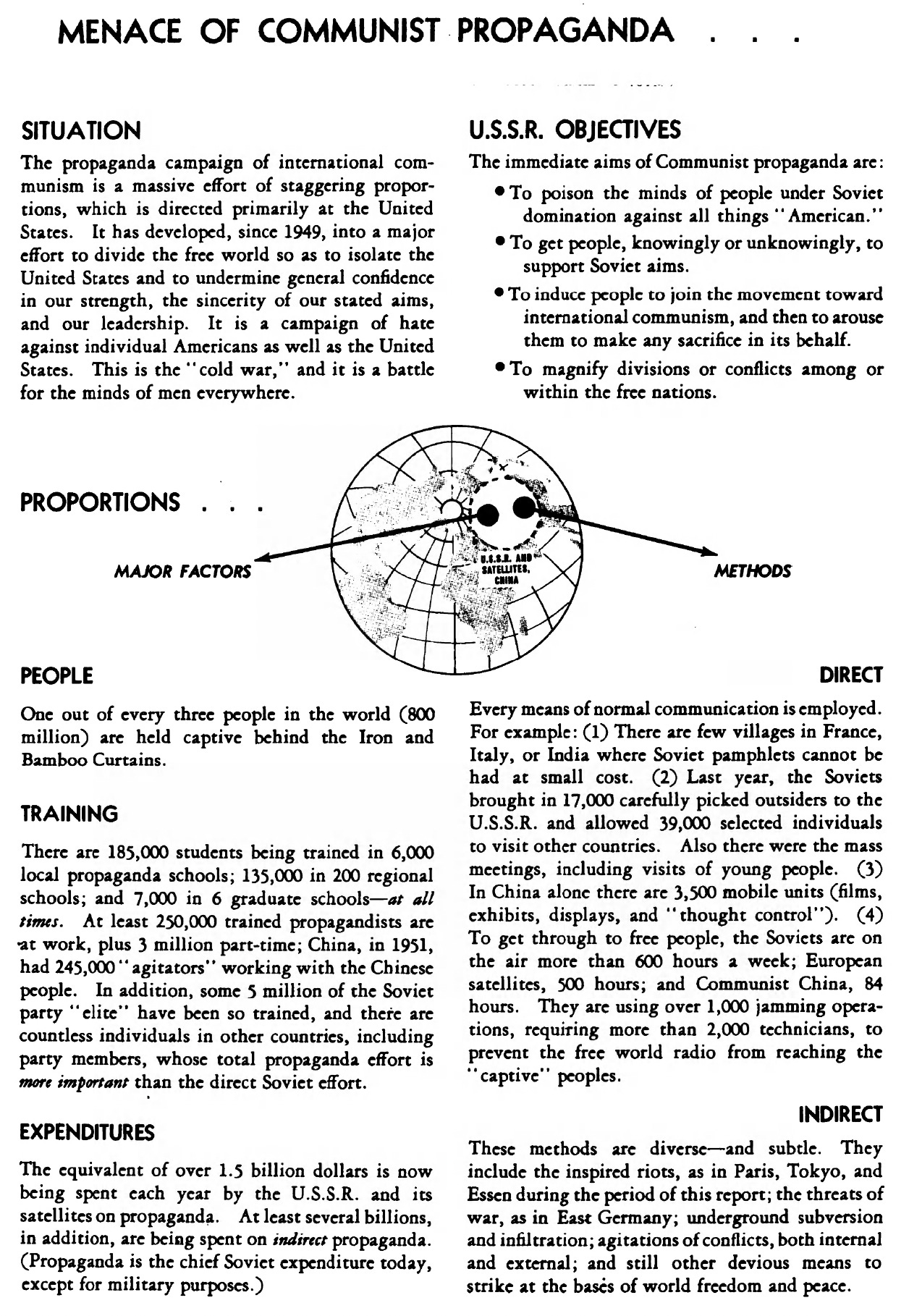
Most readers of my previous critique missed the image attached to the post—it appeared only on the Substack homepage, not in the email or the article itself. That image was a snippet from a 1953 report by a federal organization on the brink of extinction. Shortly after its release, a sliver of that agency’s authorities and responsibilities formed the US Information Agency, while the organization itself was dissolved and forgotten.
The document is a testament to our collective amnesia. I am hard-pressed to find anything substantively new in today’s “cognitive warfare” discussions that wasn’t previously detailed in that seventy-two-year-old report. It describes, in detail, the political warfare being waged against the US and our interests. Even then, in the midst of a communications revolution and a burgeoning understanding of psychological influence, those authors grasped the threat far better than we do today. They focused on the strategy, whereas we remain obsessed with the technology.
This critique shows how new labels recycle historical patterns without addressing the underlying structural dynamics.
Repackaging old concepts as novelty obscures the real misalignment between intention and systemic change.
I’m a sucker for “cognitive warfare” analyses these days, but mostly because it’s an umbrella for stuff I’m long interested in. Still, as you clarify, it’s a disappointing concept, just the latest in a string, touted mostly by military folks who are not really interested in it, ignored by offices and agencies that should be, all partly because we’re not organized to focus on it, partly because hard power, realism, realpolitik, and geopolitics dismissively govern U.S. strategic thinking.
Deeper problem: inchoate definitions of what’s “cognitive” — to include all “attitudes and behaviors” like its definers have done is so imprecise it misleads. Academic definitions of “cognition” and “cognitive science” are elusively expansive too.
How to think about cognitive warfare and what to do about it would be far better focused if cognitive warfare meant dealing specifically with people’s space-time-agency cognitions (perceptions, orientations). These are the base cognitions people acquire as babies and that, in one form or another, orient them the rest of their lives. All cognitive (political, psychological, noopolitical, etc.) warfare I know about aims to alter people’s sense of what matters spatially, where the future is headed temporally, and what they can and cannot to about it agentically. To me, it’s a no-brainer — but it also appears to be a non-starter for those who are already committed to their own and borrowed definitions.
Good case studies of the measures used to foster the Color Revolutions and Arab Spring would help. They were all about cognitive warfare. Russian and Chinese strategists know this. Good luck finding American strategists and analysts who could do a study.